


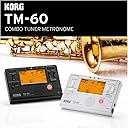
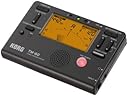
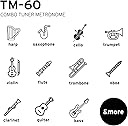
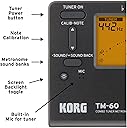



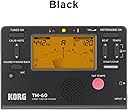
KORG TM60-BK Combo Tuner Metronome - Black
Product ID: 259034965
Details
- BrandKORG
- ColourBlack
- Connector type/
- Global Trade Identification Number
- UPC793585085295
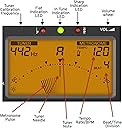
🎯High-precision tuner
💡Backlit large LCD display
⏱️Simultaneous metronome & tuner
🎵 Master your rhythm and pitch like a pro with KORG TM-60-BK!
The KORG TM60-BK Combo Tuner Metronome is a sleek, black device designed for musicians seeking precision and convenience. Featuring a high-precision tuner with a wide C1–C8 detection range and a metronome that operates simultaneously, it boasts a 1.3x larger backlit LCD for clear dual-function display. Lightweight and powered by 2 AAA batteries, it offers extended battery life, making it an essential tool for professional practice sessions in any environment.















| ASIN | B078C5HCVP |
| Brand | KORG |
| Built-In Media | 2 AAA batteries |
| Color | Black |
| Colour | Black |
| Connector Type | / |
| Connector type | / |
| Customer Reviews | 4.6 out of 5 stars 5,915 Reviews |
| Global Trade Identification Number | 04959112172357 |
| Item Type Name | Korg TM-60-BK Combo Tuner and Metronome - Black |
| Item Weight | 0.13 Kilograms |
| Manufacturer | Korg |
| Mfr Part Number | TM60BK |
| Model Number | TM60BK |
| Number of Items | 1 |
| Tuner Type | Digital |
| Tuner technology | Digital |
| UPC | 793585085295 |
| Unit Count | 1 Count |
A**R
Good product
Works well
C**N
Great features for the price
This is a great combination device for the money. Tuner: You can set middle A anywhere you want from 410 to 480 Hz in single steps and it keeps the setting when powered off. I make and play folk instruments so the default 440 is fine for me, but if you play in an orchestra you'll appreciate being able to set middle A to 442 or almost anything else. Tuning is of course standard equal temperament. It responds well to both stringed and wind instruments and I had no trouble getting it to respond correctly to any acoustic instrument, including a cow bell. Resolution is 1 cent which is great at this price range. I make Irish whistles so it's more than I need (a whistle is mostly played by ear at this resolution). I was previously making my instruments with a tuner app but the TM-60 has helped explain some # anomalies I've been having with the bell note. I think the reason is that the tuner handles harmonics much better than phone apps. If you play a major chord on a guitar it will even identify the chord correctly, so really amazing. The one thing I don't like about the tuner is that it does not indicate the octave on the screen, but on the other hand if I can't get the octave right I'm doing something very wrong. In tone generator mode it does indicate the octave (A4, C5 etc) so it does have the display capability for that feature. The tone generator is a square wave, which I don't like much for my application but it keeps the price down, and I don't really need that feature very much. It also has sound back capabilities for electric instruments but I don't need and haven't used that feature. Sound back tone generates the note put into the jack, and does work. It kind of turns the device into an automatic tone generator, but no it does not indicate the octave when you use it that way either (I tried). The tuner always turns on with the tone generator and sound back features turned off. Metronome: When I read other reviews I was concerned that the metronome would not be loud enough. It's fine, I can hear it over a session whistle. It's not going to compete with a 50W guitar amplifier, but if that is your use case you will need to mix the output from the headphone jack into your sound. I think the reason for the strange volume control (from absolutely nothing to full on a log scale) is to match roughly with a wide range of input impedances (mic or line input for example). I will probably try this eventually. The default timing is in steps corresponding to classical music - eg andante is 80 to 108 bpm in steps of 4 bpm. If you want you can change it to single steps if you just have to set 90 bpm or something and the full range is 30 to 252 bpm. There's also a "tap tempo" button which works well, but it's more of a push button than a tap pad as the name would suggest. The tone is electronic (of course) but is more of a "bop" sound rather than the annoying "beep" or "cheep" (I hate those so much) you get with most phone apps. High tone is used for beat 1, low for all other beats. Bar timing is 1 to 9 beats, and rhythm timing is march, triplets, swing(blues), quicktime and swing quicktime. For single timing you can select 1 for high tones or 0 for low tones. The metronome remembers all settings on power off including the setting to adjust for single beats. The metronome has two visual indicators - a sweep needle on the screen with beats on each extreme swing (a mechanical metronome has beat on the centre) and a flashing LED under the tap tempo button which flashes on every beat. Other features: The stated battery life (2 AAA) is 130 hours with carbon zinc batteries, supplied. Using the backlight on low gives you about 55 hours so If you use the backlight a lot you might want to use alkaline batteries. It has an auto off feature when not in use for 20 minutes, which seems reasonable. If you are using it then it won't turn off. The backlight has three settings: off low and high (36 hour carbon battery life on high) but I've found the low setting to be fine in most low light situations. You don't really need the back light in good room lighting. It remembers the backlight setting on power off. The screen has an excellent viewing angle up/down, but a very narrow viewing angle left/right, so wherever you put it should be pointing straight at you if possible. I can see it fine whether it is on the floor or on a music stand. The screen shows all relevant information and settings with the exception of the octave in tuner mode as already stated. Interestingly you can use the tuner and metronome individually or both at the same time. When used together the needle for the metronome splits to have the tuner on the top and the metronome on the bottom. The metronome beat does not interfere with the tuner. Within the limitation of price this is an excellent combo device with great features. Korg did a great job with this and I can recommend it for your gig bag or practice room. If you need a better tuner you would have to pay for a lab grade instrument, and if you want a better metronome you should probably get a drum machine.
P**O
Top per funzionalità !
Partiamo dall’unica cosa che potrebbe essere migliore: il volume del suono come metronomo. Il volume come metronomo non è altissimo, ma non ne esiste un altro di dimensioni simili che suoni più forte e ne ho provati molti in vendita su amazon. Se cerchi un metronomo con un volume di suono altissimo l’unico è il Tama RW200 che è più grosso di tre volte e costa a memoria più del doppio di questo (ed è solo metronomo). Anche i Tama più piccoli suonano come questo. Come ACCORDATORE (tuner) non ha invece concorrenti per completezza e livello di funzionamento. - Rileva TUTTE le note che sente. In altri accordatori va impostato il tipo di strumento (chitarra, ukulele, ecc) e vengono mostrate solo le note delle corde dello strumento scelto. Questo Korg invece lo puoi tenere acceso mentre canti o suoni (ad esempio un violino) e ti mostrerà ogni nota che produci e ovviamente se è calante o crescente. Non indica la ottava della nota rilevata, ma personalmente la ritengo una funzione che non serve, lo segnalo soltanto. - funzione “Sound Back”. Scoperta per caso dopo tanto tempo dall’acquisto, ma è geniale. Se colleghi le cuffie viene generata e ti fa sentire la nota (intonata ! ) che stai suonando o cantando. Ottimo strumento di training o controllo se canti o suoni uno strumento ad arco. - Volume regolabile con “rotella” per i suoni generati di riferimento, facile e immediato. Vuoi accordare il La ad orecchio ? Fai suonare in un attimo il La (o qualunque altra nota) e accordi. - LCD con retroilluminazione regolabile su due livelli o spento. È un LCD che se c’è luce si vede benissimo anche senza retroilluminazione. - Ingresso Jack per strumenti “elettrici” o microfono. Attenzione che l’uscita cuffia non replica l’ingresso Jack. - Pulsanti fusici SU e GIU dedicati e sempre attivi per scegliere velocemente la nota generata (da C3 a C6) e per scegliere gli Hz di riferimento del LA 440Hz ( “range” da 410 a 480 Hz). - Metronomo e Tuner possono funzionare contemporaneamente. Sono indipendenti uno dall'altro e ognuno con i suoi tasti. Tuner a sinistra e metronomo a destra. - Robusto. Anche se lo tengo in una custodia per portarlo i giro, mi è caduto a terra qualche volta e non ha riportato danni. Certo, mi è andata bene ed è meglio stare attenti, però robusto lo è. In conclusione uno strumento da consigliare assolutamente. Brava Korg !
D**I
Tap Tempo au top mais trop cher.
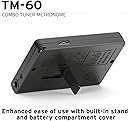
J'ai acheté ce métronome (version sans micro externe) pour remplacer celui de mon smartphone qui n'était pas si pratique. Korg, on ne présente pas, c'est bien connu et réputé. Avant tout les choses qui fâchent. L'appareil est bien livré avec un mode d'emploi, mais pour avoir le manuel utilisateur, direction internet obligatoire. Même si la plupart des gens ont un accès à internet, c'est vraiment des économies de bout de chandelle de la part de Korg, surtout pour ce prix. Toujours dans ce qui est dommage, on ne peut pas mettre un son différent. Sorti de ces détails pas bien méchants, on a dans un seul boîtier un métronome et un accordeur, ce qui est bien pratique. Surtout que l'on peut mettre un marche l'un ou l'autre ou les deux à la fois. L'appareil peut être posé à plat, sur un pupitre ou sur sa béquille. Pour la béquille, je doute qu'elle résiste bien longtemps vu son épaisseur. C'est dommage de ne pas avoir mis un plastique plus robuste mais en cas de pépin un support de téléphone devrait pouvoir remplacer. Le grand plus de cet appareil, à mon sens, c'est sa fonction Tap Tempo. Le principe est simple. On écoute un morceau, on bat la cadence en appuyant sur le bouton Tap Tempo et l'appareil affiche (et enregistre) le tempo. C'est franchement très pratique pour s'entraîner à l'accompagnement. Personnellement, je n'ai pas vu ça sur un métronome de smartphone. Pour moi, c'est la meilleure fonction de ce métronome. Je vous recommande donc cet appareil pour sa qualité, son ergonomie et cette fonction Tap Tempo. Maintenant vaut-il son prix ? Je ne le crois pas. Presque 30 euros c'est trop cher pour un écran et un programme qui pourrait tenir au large sur une carte raspeberry pi zero à 5 euros. Ca ne devrait pas dépasser le 20€ (avec le micro externe) et là , ce serait un bon rapport qualité prix.
J**N
Sehr guter Tuner - Metronom etwas leise aber sehr nützlich
Ich benutze den Tuner seit über einem halben Jahr für meine klassische Gitarre (Nylon Saiten). Wenn ich in einem ruhigen Umfeld spiele ist dies mein bevorzugter Tuner. Ich habe auch den einfacheren Korg CA-2 und habe den TM-60 als ein upgrade gekauft. Korg gibt an das, insbesondere für Gitarren und Ukulelen, der TM-60 schneller reagiert. In meiner Erfahrung ist das auch der Fall, der TM-60 hat aber eine Tendenz dazu übernervös zu sein. In der Regel tritt dies bei Saiten auf die nicht mehr ganz in Ordnung sind. Ich schätze den kleine Standfuß - das hat der CA-2 nicht. Ebenso finde ich die Anzeigenbeleuchtung nützlich, die die CA-Serie nicht bietet. Ohne die Beleuchtung ist das Display bei mäßiger Beleuchtung schlechter abzulesen als beim CA-2 dessen Anzeige besseren Kontrast zeigt - aber dann schalte ich halt die Displaybeleuchtung ein. In einem ruhigen Raum ziehe ich den TM-60 oder den CA-2 einem Cliptuner vor. In klassischer Gitarrenhaltung ist ein Cliptuner hoch oben am Kopf. Der TM-60 oder CA-2 ist vor mir auf dem Tisch/Pult und direkt abzulesen (die Wirbel finde ich ohne zu gucken). Das Metronom war für mich kein Kaufgrund, ist für mich zur Zeit aber mein meist benutztes Metronom. Besonders die "Beat einstellungen" finde ich nützlich, da merkt man besser wenn man irgendwo mal einen Schlag verschläft oder überspringt. Die optische Simulation eines klassischen Metronompendels finde ich SEHR nützlich. Die Lautstärke des Metronoms ist etwas gering, selbst für ein relative leises Instrument wie eine klassische Gitarre. Da ist mein mechanisches Wittner Piccolo einfach überlegen. Ich finde das eingebaute Metronom aber sehr bequem - den Tuner brauche ich sowieso und dann brauche ich nicht extra das Wittner zu holen. Ich habe auch ein Korg Kontaktmikrofon CM-200. Das kann ich für klassische Gitarre nicht (mehr) empfehlen. Wenn es beim Stimmen Nebengeräusche gibt (unruhiges Umfeld) benutze ich lieber meinen Cliptuner und vermeide den Kabelsalat. Der TM-60 funktioniert als Tuner nur wenn es im Umfeld relativ ruhig ist. Meine iPhone Apps (Tuner/Metronom) benutze ich nur in Notfällen (z.B. Tuner zu Hause vergessen). Ich mag den TM-60 einfach lieber. Ich benutze immer noch die erste Batterie. Alles in allem ist dies zur Zeit der Tuner/Metronom das ich am Meisten nutze.
****
Très utile et facile à utiliser
Jusqu'ici j'utilisais mon smartphone pour accorder le violoncelle. Mais c'est beaucoup plus agréable avec cet accordeur Korg. Il est très réactif et facile à employer. En plus on peut utiliser le métronome et l'accordeur en même temps. J'avais lu des réactions qui disaient que le son du métronome n'était pas assez fort. Je n'ai aucun problème à l'entendre avec le violoncelle. Pourtant, je ne dois pas le mettre au volume maximum ! La lumière clignotante de l'accordeur est aussi très pratique si on ne veut pas que le son du métronome soit trop forte. Le seul bémol de cet accordeur c'est qu'il n'indique pas la fréquence de la note jouée. Il n'y a que le nom qui est indiqué (de A à G). Donc on n'est pas capable de distinguer deux notes équivalentes, écartées d'une octave (par exemple un do grave d'un do aigu). Pour cela, j'ai encore besoin de mon smartphone. Mais cela n'est pas nécessaire pour une utilisation quotidienne, juste si je dois changer une corde cassée.
Trustpilot
2 weeks ago
3 weeks ago