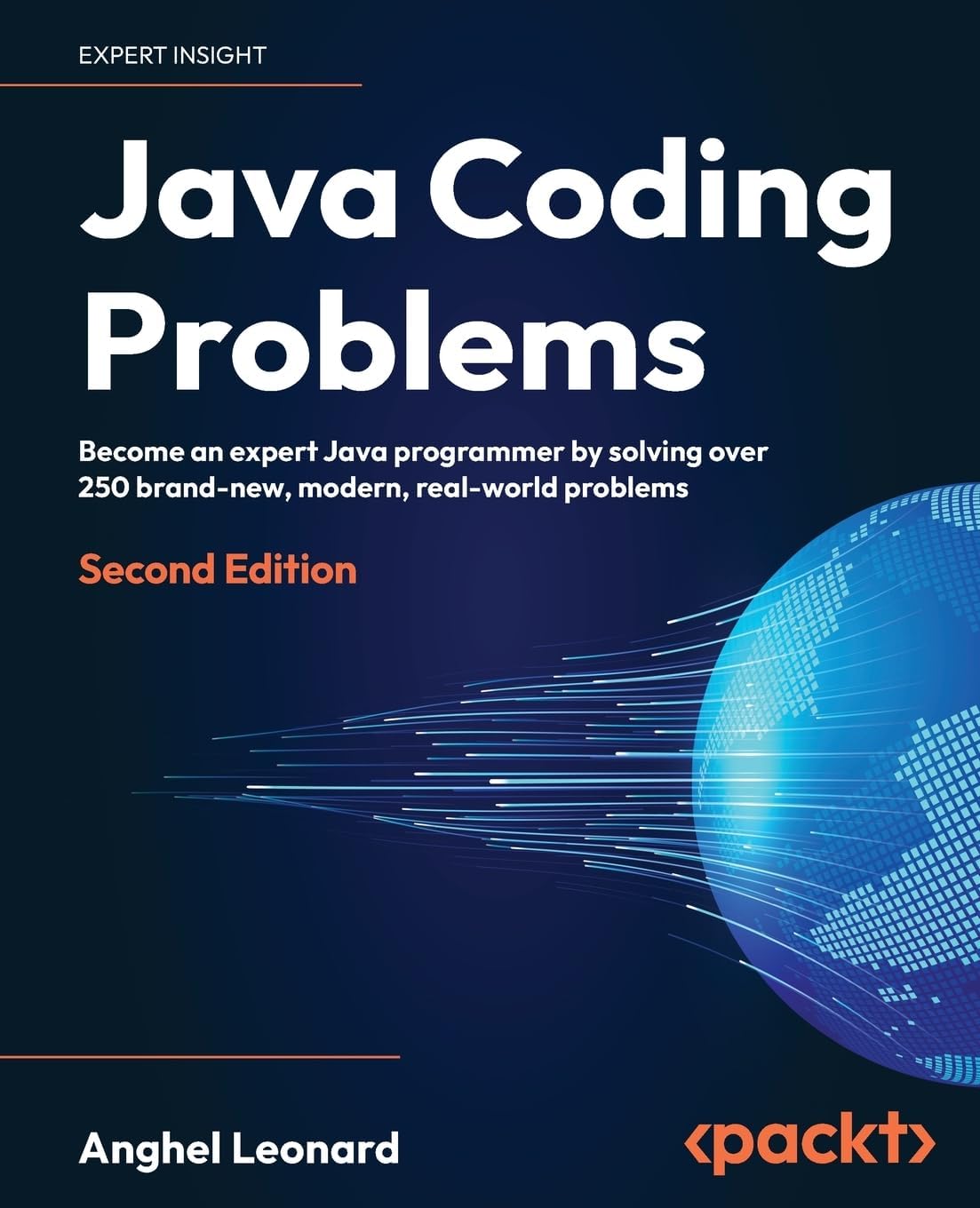
Java Coding Problems: Become an expert Java programmer by solving over 250 brand-new, modern, real-world problems
Product ID: 534037987
Buy anything from 5,000+ international stores. One checkout price. No surprise fees. Join 2M+ shoppers on Desertcart.
Desertcart purchases this item on your behalf and handles shipping, customs, and support to Cameroon.
From the Publisher Fully updated with solutions to 257 brand-new modern Java problems This second edition goes beyond a basic update and delivers to you 257 brand-new problems and solutions to help you tackle whatever Java tasks you need to take on. So, whether you’ve read Java Coding Problems, First Edition, or not, you’ll find a book filled with completely fresh and up-to-date Java challenges that will test your abilities and push you to new heights. With no problems from the first edition included, everything has been designed to meet the needs of modern Java developers. Stay up-to-date with Java by understanding the new JDK 21 features, but don’t be confined by them Java Coding Problems, Second Edition, covers everything you need to know to get up to speed with all the newest features of Java and JDK 21. You’ll find problems that utilize Record Patterns, String Templates, SplitWithDelimeters and the Math.clamp() method, along with a whole lot more. But the book does not try to make JDK 21 the solution to all Java problems. With his years of experience, author Anghel Leonard helps you select the right solution to each problem, regardless of whether that solution relies on the newest functionality or not. You’ll learn how and when to apply Java tools that range from JDK 12 to 21. Get interview ready By having access to a compendium of real-world Java problems, you’ll be able to quickly gain an understanding of a wide array of challenges, from beginner to advanced, that a Java developer will be faced with in their day-to-day work. This means that if you’re trying to break into the industry for the first time or climb the career ladder, you’ll have a huge pool of knowledge to draw from—both the solutions to specific problems and the ability to develop the tools you need to learn how to crack any coding problem—that will help you answer even the trickiest Java interview questions and get the job you want. Review: Great Java guide for solving real-world problems - It's quite some time that I have came across an exhaustive book on usage of java focusing on various modern and real-world problems. Here are some of the initial feedback that I have on the book and I am blown by the exhaustiveness and clear explanations. - The reference book provides clear and simple code samples of the problem described. - Covers some of very niche (advanced) things like stages of GC and the epoch cycles. - Consists of a dedicated chapter for Socket and consists of various examples of the usage of Simple Web Server (SWS) for some of the real world scenarios. - For someone coming from Object oriented styled programming paradigm, the book has well explained examples of functional programming in general. The book looks very promising to build a deeper level insight on Java Programming. Review: Refreshing Java workbook, great for beginners and experts alike - Anghel Leonard did a great job of putting together this excellent reference for common programming challenges found during Java development. Examples of things you will have the chance to practice and learn about from this book are: - Text manipulation - Mathematical operations - Pattern Matching and Expressions - Date and Time Operations - Advanced data structures - Deserialization - Concurrency - Garbage Collection - Socket API - Sealed and Hidden classes After you try your hand at the coding problems presented each section goes into an in-depth explanation about all the problems and their solutions. Great care is given by the author towards thoroughly explaining the ins and outs of each topic. When presenting a solution Anghel starts off by providing a history of the particular feature of the language that he is covering. I appreciated the level of detail provided in each response, and how it evolved from what you might do if using JDK 8 and then expanding into more modern solutions enabled by JDK 17 and up. Overall, I would recommend this book to beginners and experts alike. If you’ve been working with Java professionally for any length of time, I found the book a great reference point on how to perform certain tasks. I also thought that Java Coding Problems was an amazing resource to help prep for interviews where the main focus will be writing Java code. My one critique would be that I wish there was a section dedicated to applying the books knowledge to the interview process. What will be helpful for beginner’s is that the book provides a solid foundational set of skills and slowly progresses into more advanced topics that build upon the previous sections and topics.


| Best Sellers Rank | #664,454 in Books ( See Top 100 in Books ) #94 in Java Programming #462 in Computer Programming Languages #3,049 in Computer Science (Books) |
| Customer Reviews | 4.2 out of 5 stars 21 Reviews |
S**K
Great Java guide for solving real-world problems
It's quite some time that I have came across an exhaustive book on usage of java focusing on various modern and real-world problems. Here are some of the initial feedback that I have on the book and I am blown by the exhaustiveness and clear explanations. - The reference book provides clear and simple code samples of the problem described. - Covers some of very niche (advanced) things like stages of GC and the epoch cycles. - Consists of a dedicated chapter for Socket and consists of various examples of the usage of Simple Web Server (SWS) for some of the real world scenarios. - For someone coming from Object oriented styled programming paradigm, the book has well explained examples of functional programming in general. The book looks very promising to build a deeper level insight on Java Programming.
M**I
Refreshing Java workbook, great for beginners and experts alike
Anghel Leonard did a great job of putting together this excellent reference for common programming challenges found during Java development. Examples of things you will have the chance to practice and learn about from this book are: - Text manipulation - Mathematical operations - Pattern Matching and Expressions - Date and Time Operations - Advanced data structures - Deserialization - Concurrency - Garbage Collection - Socket API - Sealed and Hidden classes After you try your hand at the coding problems presented each section goes into an in-depth explanation about all the problems and their solutions. Great care is given by the author towards thoroughly explaining the ins and outs of each topic. When presenting a solution Anghel starts off by providing a history of the particular feature of the language that he is covering. I appreciated the level of detail provided in each response, and how it evolved from what you might do if using JDK 8 and then expanding into more modern solutions enabled by JDK 17 and up. Overall, I would recommend this book to beginners and experts alike. If you’ve been working with Java professionally for any length of time, I found the book a great reference point on how to perform certain tasks. I also thought that Java Coding Problems was an amazing resource to help prep for interviews where the main focus will be writing Java code. My one critique would be that I wish there was a section dedicated to applying the books knowledge to the interview process. What will be helpful for beginner’s is that the book provides a solid foundational set of skills and slowly progresses into more advanced topics that build upon the previous sections and topics.
A**A
Great Reference for using Java
Sometimes, I need to update some Java code and this has become helpful for some of the issues I ran into. This is a highly recommended resource for Java devs who are just beginning and those with many years experience.
L**R
Looking for Java problems to solve? Don’t buy this book.
The book title and description may lead you to believe that the book contains 250 exercises to solve. It does not. It’s just a list of examples, not problems. And as such, it’s a waste of time for those who preferred to learn by doing. If you’re one of those people. Avoid this book.
O**F
Learn by coding, not by reading.
The publisher, Packt, asked me to review the book Java Coding Problems. When I began programming on an Apple ][+ in 1980 I scoured every bookshop for books on programming. I did not want to read about programming but rather I acquired books that used multiple snippets of code that I could enter and manipulate. It was how I learned to write code. I’d take a basic example of what I wanted to accomplish and then poke, prod, and experiment with the code to achieve an objective. There were not many books in the 80s that met this need for me. Java Coding Problems, Second Edition, by Anghel Leonard is a book that would have made my life so much easier had it been available when I started programming in Java in 1998. This book takes a PBL or Problem Based learning approach. Each chapter begins with a series of problems that you can solve using Java. Each problem is direct and focuses on an aspect of the language in a range of domains. The domains are defined by the chapters. Not only does every chapter begin with problems but in the chapters are detailed descriptions of the solutions. The author’s solution to every problem can also be found in the book’s GitHub repository. The book may appear intimidating with its 765 pages but that is only because of the breadth of problems in the domains. Every problem’s solution is carefully laid out. This is not necessarily a book that you sit down to read cover to cover but rather it is somewhat like a dictionary. For example, in Chapter 5 Arrays, Collections, and Data Structures one problem is: 108. Covering the Vector API’s structure and terminology: Explain with examples the Vector API terminology. Cover notions such as element type, shape, species, lanes, and so on. This problem will have you learning about the new Vector API of Java, an API that is of great significance in machine learning. You can either accept the challenge to explain Vectors or examine the solution from the book that you could then use as the basis of a problem you have that can be solved with the Vector API. This is not a beginner’s book. It does require some familiarity with Java. What it will do for you is push you into expanding your knowledge of the Java language by way of writing code to help you understand what the domains of the language can be used for.
J**E
Covers a lot of ground really well
Java Coding Problems is one of those books you probably don't need until you do, and, given the sheer size of it, there's a good chance that need will come along quicker than you think. At a whopping 798 pages, it's a book that covers problems as prosaic as string formatting and date handling, to concurrency and socket programming. Over the course of 13 chapters, almost 300 different problems from a wide range of categories are neatly described and then solved, showing approaches and APIs (where applicable) using JDKs as far back as Java 8 (for those who can't update) all the way to Java 21. In clear, easy-to-read text, the problem is presented, dissected, then solved, with robust explations for each solution. The topics in the book are basic enough for beginning programmers who need a resource to solve unfamiliar problems, and advanced enough that veteran programmers can find help on, say, issues that aren't common in their day-to-day: - Need help with multiline strings? Chapter 1 - Need to implement or debug a K-D Tree? Chapter 5 - Need to call C++ code? Turn to chapter 7 - Having performance issues in product? Perhaps you GC is the issue, so flip to chapter 12 For these problems and literally hundreds more, you'll find source code and screen shots to help study for an exam or interview, or maybe to solve that problem a coworker left for you. Or, if you're the insatiably curious type, you'll find lots of problems you didn't know existed (along with their solutions, of course). I suspect there's something in this book for everyone not on the Java development team. :) Full disclosure: I was sent a review copy of this book and asked for an honest review, no strings attached. I'll get nothing for this review, and these are my honest thoughts.
S**S
Essential Guide to JDK 21 Features and Best Practices
Mastering Modern Java is essential for any Java developer keen on understanding JDK 21's latest features. It provides a detailed look at modern Java capabilities, from Records and Sealed Classes to Context-Specific Deserialization Filters, each explained with practical examples to simplify applications in real-world scenarios. The book excels in elucidating advanced data handling, security enhancements, and system architecture optimization. It also covers new APIs and modern garbage collection techniques, making it a valuable resource for enhancing both knowledge and practical skills in Java. Recommended for its thoroughness and real-world applicability.
M**A
Great book for any level Java developer
I really like this book. I am a Senior Java engineer and think It will be useful for any Java fan of any level. Book is built like problem-solving that is very actual for nowadays comparing and explanations features from the very first Java versions till new features of Java 21. Besides code examples really good, clear structure and running without any problem, there are examples also with benchmark. It is easy to check theory by your own for me this is very important. The most I liked explanations of project Loom, Virtual threads because it is a completely new theme for me but after book I'm ready to use it in a project. Also found new useful information and problem solving for strings, switch, collections, records.
Trustpilot
2 months ago
1 month ago